Detailed description
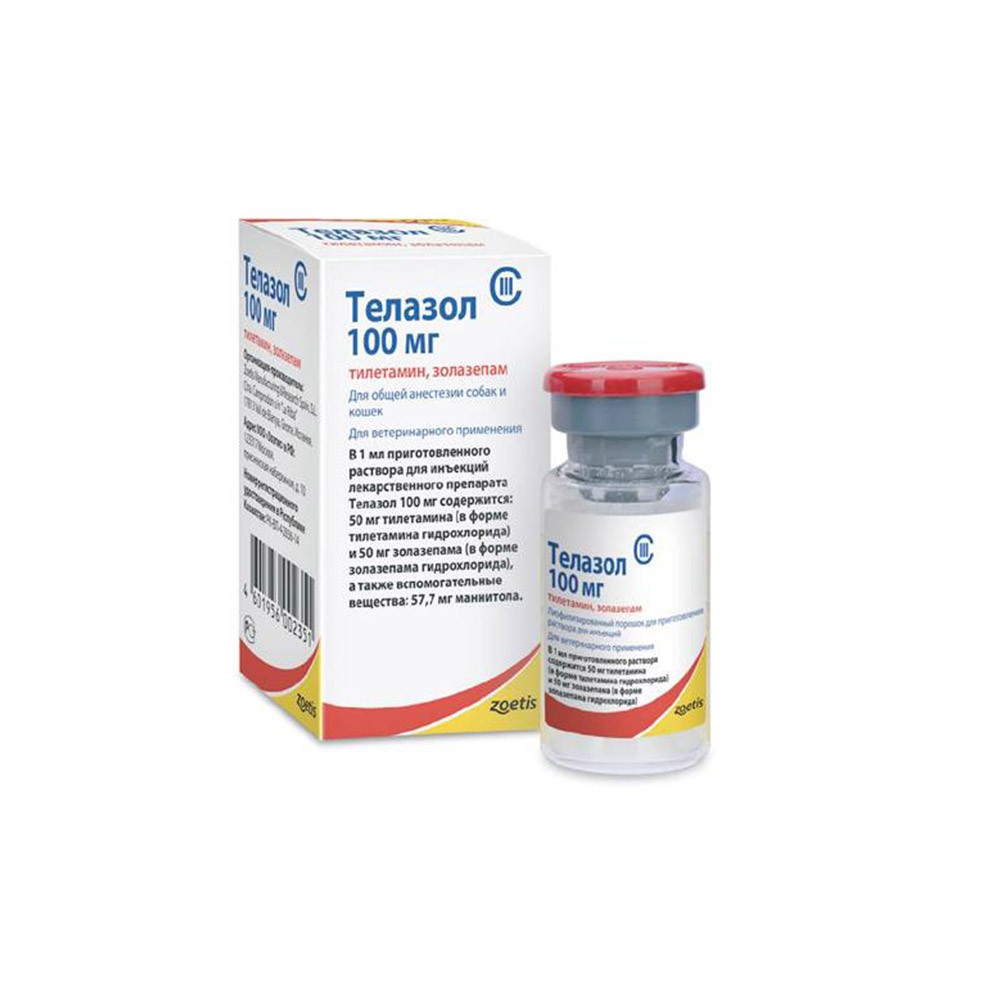
TELAZOL
(tiletamine and zolazepam for injection)
RAPID-ACTING ANESTHETIC COMBINATION FOR USE IN DOGS AND CATS
DESCRIPTION
TELAZOL (tiletamine and zolazepam for injection) is a nonnarcotic, nonbarbiturate, injectable anesthetic agent for dogs and cats. Chemically, TELAZOL is a combination of equal parts by weight of base of tiletamine hydrochloride (2-[ethylamino]-2-[2-thienyl]-cyclohexanone hydrochloride), an arylaminocycloalkanone dissociative anesthetic, and zolazepam hydrochloride (4-[o-fluorophenyl]-6, 8-dihydro-1,3,8- trimethylpyrazolo [3, 4-e][1,4] diazepin-7 [1H]-1- hydrochloride), a nonphenothiazine diazepinone having minor tranquilizing properties. The product is supplied sterile in vials. The addition of 5 mL diluent produces a solution containing the equivalent of 50 mg tiletamine base, 50 mg zolazepam base and 57.7 mg mannitol per milliliter. This solution has a pH of 2 to 3.5 and is recommended for deep intramuscular injection.
INDICATIONS:
Dogs: For induction of general anesthesia followed by maintenance with an inhalant anesthetic.
For restraint and minor procedures of short duration (30 min. avg.) requiring mild to moderate analgesia.
Cats: For restraint or for anesthesia combined with muscle relaxation.
DOSAGE AND ADMINISTRATION
Dogs
Intramuscular (IM) For Restraint and Minor Procedures of Short Duration Requiring Mild to
Moderate Analgesia:
In healthy dogs, an initial intramuscular dosage of 3 to 4.5 mg/lb (6.6 to 9.9 mg/kg)
TELAZOL is recommended for diagnostic purposes; 4.5 to 6 mg/lb (9.9 to 13.2 mg/ kg) for minor procedures of short duration, such as treatment of lacerations and wounds, castrations and other procedures requiring mild to moderate analgesia. When supplemental doses of TELAZOL are required, such individual supplemental doses should be less than the initial dose, and the total dose given (initial dose plus supplemental dose or doses) should not exceed 12 mg/lb (26.4 mg/kg). The maximum safe dose is 13.6 mg/lb (29.92 mg/kg). (See Animal Safety.) Results from TELAZOL anesthesia in dogs will be more satisfactory if the procedures are completed within one hour and if the procedures can be completed following single dose administration. In order to maintain at least a 2X margin of safety in dogs, the use of this product is limited to procedures that call for low doses (see Indications). Studies show that there is variation in response to different dosages of TELAZOL and that low doses do not give adequate levels of anesthesia, and in some instances do not give adequate analgesia, for extensive procedures.
Intravenous (IV) For Induction of Anesthesia Followed by Maintenance with an Inhalant Anesthetic:
In dogs, for induction of anesthesia, administerTELAZOL intravenously at 1-2 mg/lb (2.2-4.4 mg/kg) body weight to effect. TELAZOL should be administered slowly, over 30-45 seconds; after approximately 30-60 seconds, the dog’s level of consciousness, muscle relaxation, and jaw tone should be assessed to determine the ability to intubate. If after waiting 60 seconds the dog’s level of anesthesia is not sufficient for successful intubation, additional TELAZOL may be administered; the total dose should not exceed 2 mg/lb (4.4 mg/kg) body weight.
Cats
In healthy cats, an initial TELAZOL dosage of 4.4 to 5.4 mg/lb (9.7 to 11.9 mg/kg) IM is recommended for such procedures as dentistry, treatment of abscesses, foreign body removal and related types of surgery; 4.8 to 5.7 mg/lb (10.6 to 12.5 mg/kg) for minor procedures requiring mild to moderate analgesia, such as repair of lacerations, castrations and other procedures of short duration. Initial dosages of 6.5 to 7.2 mg/ lb (14.3 to 15.8 mg/kg) are recommended for ovario hysterectomy and onychectomy. When supplemental doses of TELAZOL are required, such individual supplemental doses should be given in increments that are less than the initial dose, and the total dose given (initial dose plus supplemental doses) should not exceed the maximum allowable safe dose of 32.7 mg/lb (72 mg/kg). (See Animal Safety.)
General Dosing Information
Fasting prior to induction of general anesthesia with TELAZOL is not essential; however, when preparing or elective surgery, it is advisable to withhold food for at least 12 hours prior to TELAZOL administration. As with other injectable anesthetic agents, the individual response to TELAZOL is somewhat varied, depending upon the dose, general physical condition and age of the patient, duration of the surgical procedure, and any preanesthetics used. Therefore, recommendations for dosage regimens cannot be fixed absolutely. Specific dosage requirements must be determined by evaluation of the health status and condition of the patient and of the procedure to be performed. Recovery varies with the age and physical condition of the animal and the dose of TELAZOL administered. Recovery is extended with high dose or multiple injections, particularly in cats.
Intramuscular injection in dogs and cats:
There may be pain on injection. This is especially prevalent in cats.
Following a single, deep intramuscular injection of TELAZOL in cats and dogs, onset of anesthetic effect usually occurs within 5 to 12 minutes. Muscle relaxation is optimum for approximately the first 20 to 25 minutes after TELAZOL is administered, and then diminishes. Repeated doses increase the duration of the effect of TELAZOL but may not further diminish muscle tone. The quality of anesthesia with repeated doses varies because the ratio of the two components within the animal’s body changes with each injection. This is due to the difference in the rates of metabolism and elimination of the two components. The quality of anesthesia will be improved and more predictable if the entire dose is given as a single injection rather than i several doses. The best method of evaluating the depth of TELAZOL anesthesia is to monitor the patient for deliberate conscious response to nociceptive stimuli. If adequate anesthesia is not produced by the recommended dosage regimen, supplemental anesthesia or another agent is indicated. This includes the use of barbiturates and volatile anesthetics. When used concurrently with TELAZOL the dosage of these agents should be reduced.
PREPARATION OF SOLUTION FOR ADMINISTRATION
To each vial add 5 mL sterile water for injection, USP. Slight agitation will facilitate complete reconstitution. The resultant solution will contain 100 mg total TELAZOL per one milliliter (50 mg tiletamine and 50 mg zolazepam per mL). Discard unused solution after 7 days when stored at room temperature or after 56 days when kept refrigerated. Only use clear solution. Color of solution may vary from colorless to light amber.
CONTRAINDICATIONS
The use of TELAZOL is contraindicated in dogs and cats with pancreatic disease. TELAZOL is excreted predominantly by the kidneys. Preexistent renal pathology or impairment of renal function may be expected to result in prolonged duration of anesthesia. TELAZOL should not be used in dogs and cats with severe cardiac or pulmonary dysfunction. Because the teratogenic potential of TELAZOL is unknown, it should not be used in pregnant bitches or queens at any stage of pregnancy. Also, a study has shown that TELAZOL crosses the placental barrier and produces respiratory depression in the newborn; therefore, its use for Cesarean section is contraindicated.
WARNINGS
FOR USE IN DOGS AND CATS ONLY.
When using TELAZOL for induction of anesthesia, patients should be continuously monitored. Facilities for the maintenance of a patent airway, artificial ventilation and oxygen supplementation should be available.
Pulmonary edema has been reported to occur in cats with the use of TELAZOL. Signs and symptoms include dyspnea, lethargy, anorexia and abnormal behavior. Deaths have been reported occasionally in severely affected individuals. Cats should be observed closely for any signs and symptoms
which may suggest pulmonary edema so that appropriate therapy may be instituted. The principal route of excretion of both components in the cat is the urine; therefore, TELAZOL is not recommended for use in cats suffering from renal insufficiency.
Balance studies in dogs indicated extensive biotransformation of both components with less than 4% of the dose excreted unchanged in the urine.
TELAZOL is excreted predominantly by the kidneys. Preexistent renal pathology or impairment of renal function may be expected to result in prolonged duration of anesthesia. Phenothiazine-derivative drugs should not be used with TELAZOL at dosages indicated for intramuscular (IM) injection because the combination produces respiratory and myocardial depression, hypotension and hypothermia. The safe use of TELAZOL in pregnant animals or on reproduction has not been established.
TELAZOL crosses the placental barrier and causes respiratory depression in the neonate.